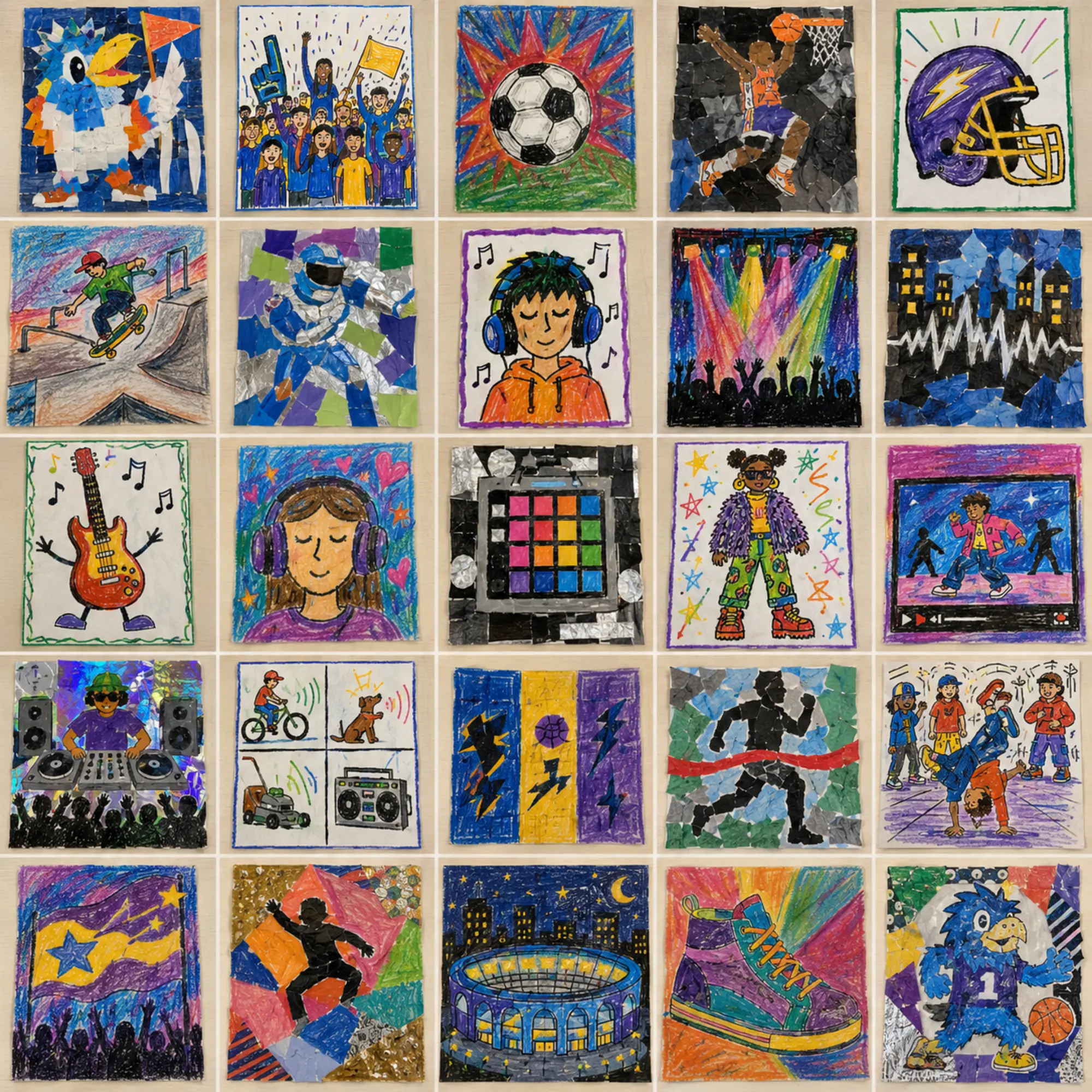
 SUCCESS EXAMPLE · NOT A TEMPLATE1553
Grade 1 · LESSON 188 OF 354
Team Colors Trading Card Set with Oil Pastel
Make a trading card set showing an original color system that communicates unity without a real logo. Use the example for ideas, but choose your own subject, colors, arrangement, and details.
Invite a quick plan, a material test, and one change after a partner notice-and-wonder. Use the readiness check below to choose the starting point. Grade is a guide, not a limit on an individual learner. The example image is inspiration, not a required level of finish.
Right-sized challenge · Grade 1
Core goal: Plan one main idea, practice one technique, and explain a choice. Project skill: Test tool pressure or water load before making the main marks.
Before starting: Ask the student to demonstrate the main tool action and say what they want to make.
If it feels too hard: Reduce the project to one subject and rehearse the next step beside an adult.
If the skill is already secure: Try two arrangements of the same subject and explain which communicates better.
Adult support: Use a simple visual sequence. Accept spoken, drawn, or dictated reflection.
Time: Plan in 45-minute meetings. Continue next meeting for drying, building, or unfamiliar techniques; do not rush completion.
Safety: Use school-approved, age-labeled materials. Adults manage sharp cutting, heated tools, aerosols, and specialty equipment. Avoid loose small parts for children who mouth objects; check allergies. Preview all outside images and links; children do not browse or create public accounts independently.
Suggested teaching starting points, not fixed ability bands. Adjust after observing the learner. Informed by NAEYC process-art guidance and the National Core Arts Standards framework.THE STUDIO GUIDE'S PROJECT PLAN
What students are making
Make a trading card set showing an original color system that communicates unity without a real logo. Use the example for ideas, but choose your own subject, colors, arrangement, and details.
Student directions
- 1
Make this: a trading card set showing an original color system that communicates unity without a real logo.
- 2
Your core skill today: Test tool pressure or water load before making the main marks.
- 3
Make a quick sketch. Label the main shapes, colors, parts, and where they will go.
- 4
Draw the largest shapes first. Add lines, patterns, texture, value, and color that help the viewer understand the idea.
- 5
Stop halfway. Compare the work to the project goal—not to another student’s art. Fix, add, remove, move, or strengthen one part.
- 6
Finish the important details. Make sure every loose part is attached and the main idea is easy to notice.
- 7
Share the work. Explain one choice and one change you made. Photograph or display it, then clean the workspace.
Artist connection
Wangechi Mutu OPEN MUSEUM OR GOOGLE ARTS & CULTURE RESOURCEinvestigate hybrid forms, collage, identity, and imagined futures.
Teaching rule: borrow the artist’s question, process, material thinking, or relationship to audience—not a recognizable style.
Current art-world practice
Installation art: materials transform a specific place for a period of time.
Ask students where they might encounter this practice today: a museum, public space, screen, community event, landscape, or temporary installation.
Teacher preparation
- Use school-approved, age-labeled materials. Adults manage sharp cutting, heated tools, aerosols, and specialty equipment. Avoid loose small parts for children who mouth objects; check allergies. Preview all outside images and links; children do not browse or create public accounts independently.
- Prepare oil pastels and heavy drawing paper in table groups; keep specialty materials at a distribution station.
- Preview the artist connection, choose one age-appropriate artwork for discussion, and avoid assigning students to copy a recognizable style.
- Print the matching worksheet and prepare a drying, display, testing, or photography area.
- Make one technique sample and one deliberately unsuccessful sample; do not make a finished project for copying.
Demonstration notes
- Show how to use and return the primary tools for oil pastel.
- Model the key action slowly, narrating hand position, pressure, attachment, sequencing, or layering.
- Show how to test a small area before committing to the final surface.
- Demonstrate one repair: cover, crop, reinforce, reconnect, remix, or intentionally incorporate an accident.
Learning goals
- Explore how oil pastel can communicate an idea.
- Make two purposeful artistic choices.
- Explain a revision.
Materials
- oil pastels
- heavy drawing paper
- blending stumps or cotton swabs
- scrap paper for color tests
- table protection
- cleanup supplies
- optional student-proposed safe materials
Teaching sequence
- 1
0–5 MIN · CHECK READINESS — Ask the student to demonstrate the main tool action and say what they want to make.
- 2
5–10 MIN · MODEL — Test tool pressure or water load before making the main marks. Use this lesson's demonstration notes.
- 3
10–15 MIN · TEST — Practice the main action on a small sample. Use the support option if it is not yet comfortable.
- 4
15–35 MIN · MAKE — Follow this lesson's student directions. Check the core skill before adding complexity.
- 5
35–40 MIN · REVIEW — Plan one main idea, practice one technique, and explain a choice.
- 6
40–45 MIN · CLEAN + RECORD — Save work safely. Note the next step if another meeting is needed.
What success looks like
- The finished work clearly shows a trading card set showing an original color system that communicates unity without a real logo
- Materials and tools are controlled safely
- The student identifies one intentional choice
- The work meets the project constraint while remaining original
- Grade-level evidence: Plan one main idea, practice one technique, and explain a choice. Test tool pressure or water load before making the main marks.
Teacher questions
- What should a viewer notice first?
- How does this material help communicate the idea?
- How is this connected to the artist’s question without copying the artist’s style?
- What did you discover while making?
Common problems + responses
- Students copy the success image — cover it after observation and require a changed subject, structure, material, or color decision.
- The artist connection becomes imitation — return to the artist’s big question, process, or use of audience instead of surface appearance.
- Materials fail — pause for a joining or mark test using scraps.
- Cleanup replaces reflection — assign table jobs before distributing materials.
Access + differentiation
- Reduce the project to one subject and rehearse the next step beside an adult.
- Offer adapted grips, a stabilized surface, rest breaks, and spoken or dictated responses. Adjust access without taking over the creative decisions.
- Try two arrangements of the same subject and explain which communicates better.
Material substitutions
- No specialty material: translate the project into paper, cardboard, tape, and drawing tools.
- No camera or tablet: use a viewfinder drawing or sequential storyboard.
- Short class: finish planning and one focused study; continue construction next meeting.
- Advanced studio: change scale, audience, site, or material while preserving the core idea.
Four-part assessment rubric
IDEA — The project communicates an original response.
CRAFT — Materials are controlled, connected, and cared for.
PROCESS — The student plans, tests, persists, and revises.
REFLECTION — The student explains a choice using evidence.
Vocabulary
Student reflection
What did you notice? Which choice feels most like yours? What would you change next?
National Core Arts Standards
VA:Cr1.1.1a — Brainstorm art ideas
VA:Cr2.1.1a — Explore materials to express ideas
VA:Cr3.1.1a — Explain choices
STUDENT PROMPT