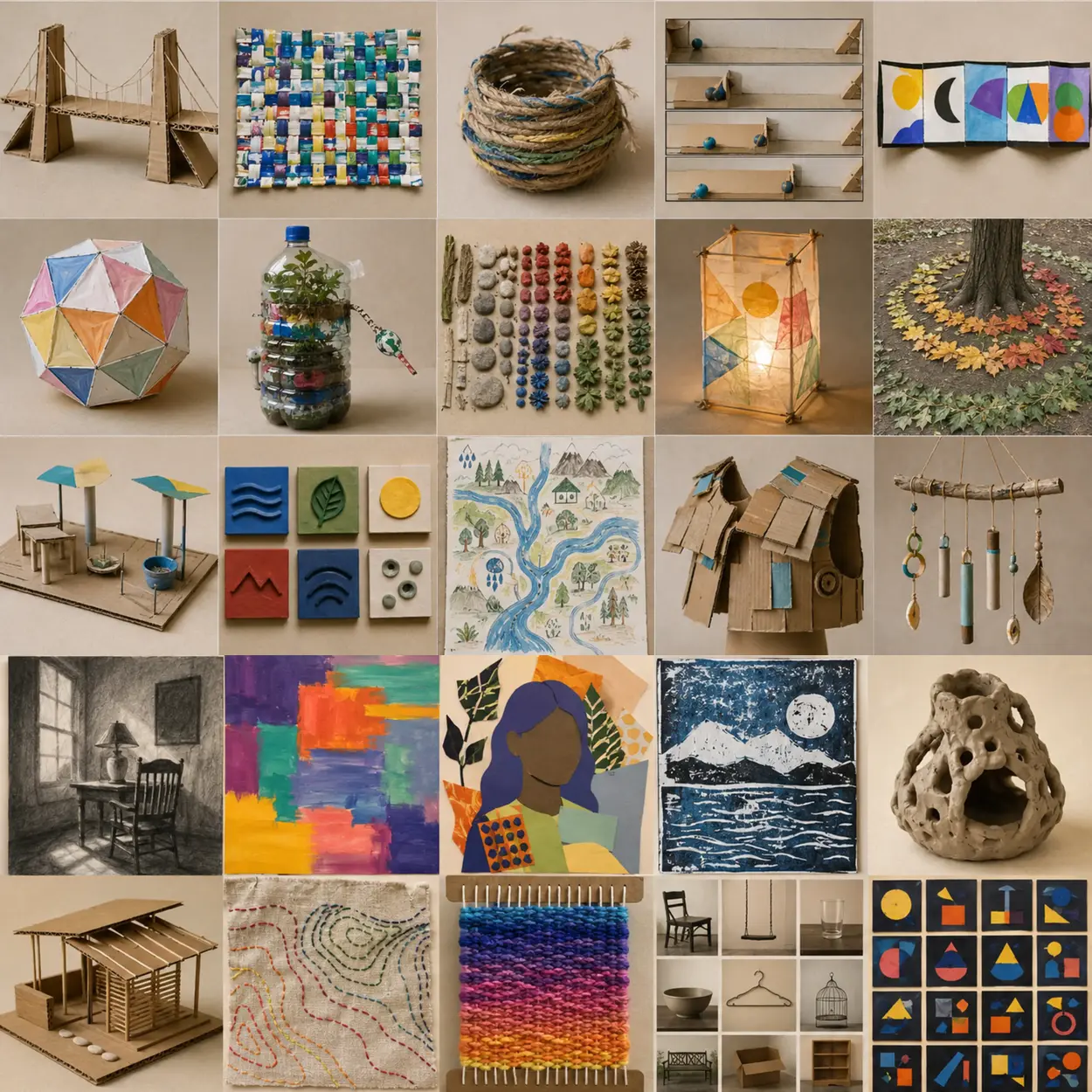
 SUCCESS EXAMPLE · NOT A TEMPLATE245
Grade 3 · LESSON 5 OF 519
Hollow Clay Organic Sculpture
Make hollow clay organic sculpture. Use the example for ideas, but choose your own subject, colors, arrangement, and details.
Require a thumbnail or prototype, purposeful material choices, and an evidence-based revision. Use the readiness check below to choose the starting point. Grade is a guide, not a limit on an individual learner. The example image is inspiration, not a required level of finish.
Right-sized challenge · Grade 3
Core goal: Make a short plan, use a technique deliberately, and revise one area for a stated reason. Project skill: Plan a balanced form and test the stability of its joins.
Before starting: Can the student make a controlled trial and identify what they want to improve?
If it feels too hard: Model the technique on a small sample and narrow the final work to one focal area.
If the skill is already secure: Compare two possible revisions and explain which best supports the intended effect.
Adult support: Use a midpoint check. Separate unfamiliar technique practice from the final piece.
Time: Plan in 45-minute meetings. Continue next meeting for drying, building, or unfamiliar techniques; do not rush completion.
Safety: Use school-approved, age-labeled materials. Adults manage sharp cutting, heated tools, aerosols, and specialty equipment. Avoid loose small parts for children who mouth objects; check allergies. Preview all outside images and links; children do not browse or create public accounts independently.
Suggested teaching starting points, not fixed ability bands. Adjust after observing the learner. Informed by NAEYC process-art guidance and the National Core Arts Standards framework.THE STUDIO GUIDE'S PROJECT PLAN
What students are making
Make hollow clay organic sculpture. Use the example for ideas, but choose your own subject, colors, arrangement, and details.
Student directions
- 1
Make this: hollow clay organic sculpture.
- 2
Your core skill today: Plan a balanced form and test the stability of its joins.
- 3
Make a quick sketch. Label the main shapes, colors, parts, and where they will go.
- 4
Build the largest solid forms first. Join parts securely, test the balance, then add surface texture and important details.
- 5
Stop halfway. Compare the work to the project goal—not to another student’s art. Fix, add, remove, move, or strengthen one part.
- 6
Finish the important details. Make sure every loose part is attached and the main idea is easy to notice.
- 7
Share the work. Explain one choice and one change you made. Photograph or display it, then clean the workspace.
Artist connection
Yayoi Kusama OPEN MUSEUM OR GOOGLE ARTS & CULTURE RESOURCEdiscuss accumulation, repetition, and immersive space without copying her signature motifs.
Teaching rule: borrow the artist’s question, process, material thinking, or relationship to audience—not a recognizable style.
Current art-world practice
Immersive art: light, sound, scale, and movement surround the viewer.
Ask students where they might encounter this practice today: a museum, public space, screen, community event, landscape, or temporary installation.
Teacher preparation
- Use school-approved, age-labeled materials. Adults manage sharp cutting, heated tools, aerosols, and specialty equipment. Avoid loose small parts for children who mouth objects; check allergies. Preview all outside images and links; children do not browse or create public accounts independently.
- Prepare air-dry clay or classroom clay and clay tools in table groups; keep specialty materials at a distribution station.
- Preview the artist connection, choose one age-appropriate artwork for discussion, and avoid assigning students to copy a recognizable style.
- Print the matching worksheet and prepare a drying, display, testing, or photography area.
- Make one technique sample and one deliberately unsuccessful sample; do not make a finished project for copying.
Demonstration notes
- Show how to use and return the primary tools for clay and ceramic media.
- Model the key action slowly, narrating hand position, pressure, attachment, sequencing, or layering.
- Show how to test a small area before committing to the final surface.
- Demonstrate one repair: cover, crop, reinforce, reconnect, remix, or intentionally incorporate an accident.
Learning goals
- Explore how clay and ceramic media can communicate an idea.
- Make three connected artistic choices.
- Explain a revision.
Materials
- air-dry clay or classroom clay
- clay tools
- texture objects
- work boards
- table protection
- cleanup supplies
- optional student-proposed safe materials
Teaching sequence
- 1
0–5 MIN · CHECK READINESS — Can the student make a controlled trial and identify what they want to improve?
- 2
5–10 MIN · MODEL — Plan a balanced form and test the stability of its joins. Use this lesson's demonstration notes.
- 3
10–15 MIN · TEST — Practice the main action on a small sample. Use the support option if it is not yet comfortable.
- 4
15–35 MIN · MAKE — Follow this lesson's student directions. Check the core skill before adding complexity.
- 5
35–40 MIN · REVIEW — Make a short plan, use a technique deliberately, and revise one area for a stated reason.
- 6
40–45 MIN · CLEAN + RECORD — Save work safely. Note the next step if another meeting is needed.
What success looks like
- The finished work clearly shows hollow clay organic sculpture
- Materials and tools are controlled safely
- Feedback or testing leads to a visible revision
- The work meets the project constraint while remaining original
- Grade-level evidence: Make a short plan, use a technique deliberately, and revise one area for a stated reason. Plan a balanced form and test the stability of its joins.
Teacher questions
- What should a viewer notice first?
- How does this material help communicate the idea?
- How is this connected to the artist’s question without copying the artist’s style?
- What evidence shows the revision improved the work?
Common problems + responses
- Students copy the success image — cover it after observation and require a changed subject, structure, material, or color decision.
- The artist connection becomes imitation — return to the artist’s big question, process, or use of audience instead of surface appearance.
- Materials fail — pause for a joining or mark test using scraps.
- Cleanup replaces reflection — assign table jobs before distributing materials.
Access + differentiation
- Model the technique on a small sample and narrow the final work to one focal area.
- Offer adapted grips, a stabilized surface, rest breaks, and spoken or dictated responses. Adjust access without taking over the creative decisions.
- Compare two possible revisions and explain which best supports the intended effect.
Material substitutions
- No specialty material: translate the project into paper, cardboard, tape, and drawing tools.
- No camera or tablet: use a viewfinder drawing or sequential storyboard.
- Short class: finish planning and one focused study; continue construction next meeting.
- Advanced studio: change scale, audience, site, or material while preserving the core idea.
Four-part assessment rubric
IDEA — The project communicates an original response.
CRAFT — Materials are controlled, connected, and cared for.
PROCESS — The student plans, tests, persists, and revises.
REFLECTION — The student explains a choice using evidence.
Vocabulary
Student reflection
What did you notice? Which choice feels most like yours? What would you change next?
National Core Arts Standards
VA:Cr1.1.3a — Elaborate imaginative ideas
VA:Cr2.1.3a — Create personally satisfying art
VA:Cr3.1.3a — Revise through reflection
STUDENT PROMPT