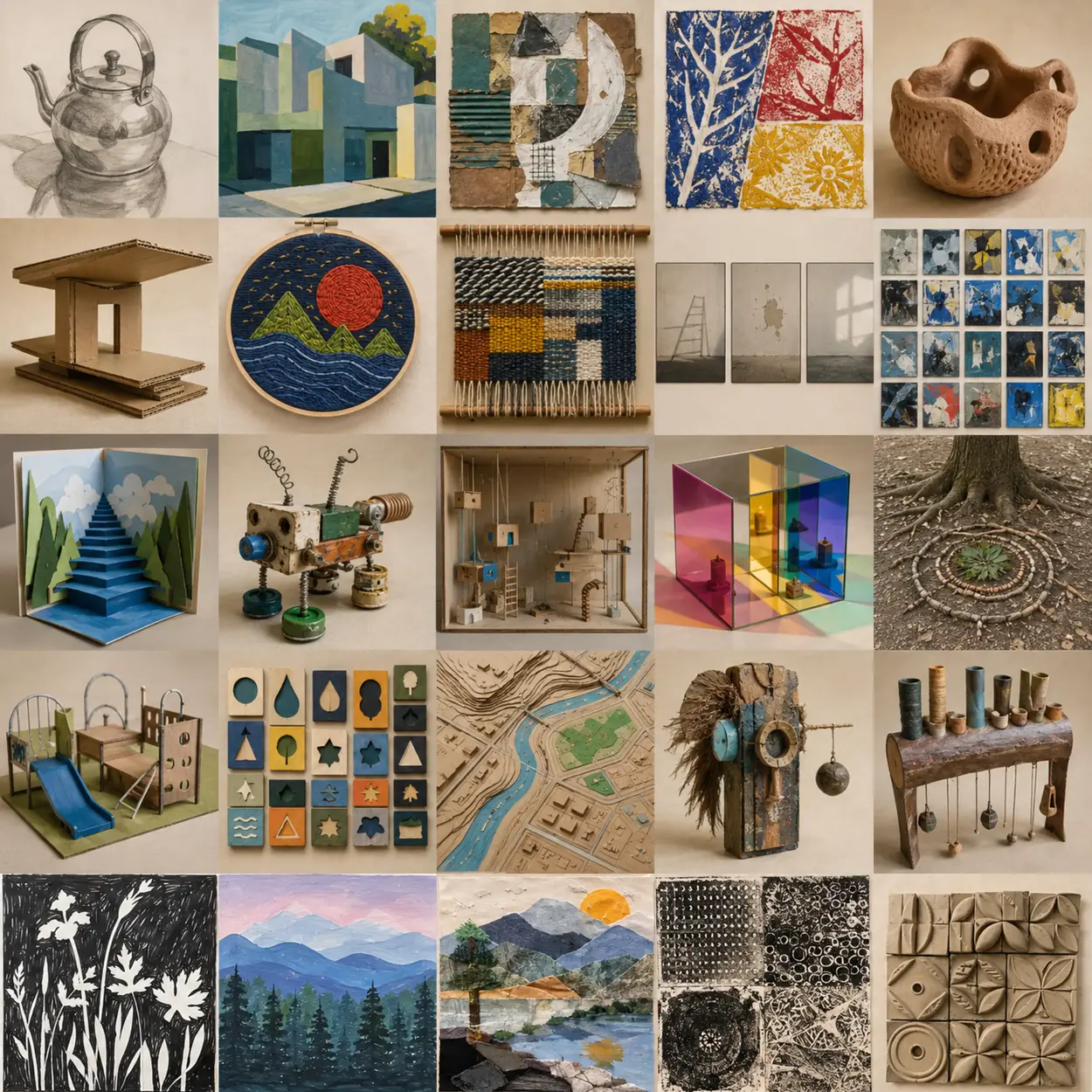
 SUCCESS EXAMPLE · NOT A TEMPLATE301
Grade 4 · LESSON 1 OF 584
Graphite Reflected-Object Observational Drawing
Make a drawing on paper of graphite reflected-object observational drawing. Practice value using drawing marks only. Choose your own details and arrangement.
Students establish criteria, manage materials, and use critique to strengthen communication. Use the readiness check below to choose the starting point. Grade is a guide, not a limit on an individual learner. The example image is inspiration, not a required level of finish.
Right-sized challenge · Grade 4
Core goal: Compare two plans and refine technique to guide the viewer’s attention. Project skill: Compare angles and relative sizes where relevant; refine the lesson’s drawing technique in one area.
Before starting: Can the student explain a technique choice and use feedback to identify a next step?
If it feels too hard: Provide a worked technique sample and a small-format study before the full project.
If the skill is already secure: Test a different viewpoint or arrangement; defend the choice using visible evidence.
Adult support: Students plan materials and checkpoints; adults supervise unfamiliar tools and processes.
Time: Plan in 45-minute meetings. Continue next meeting for drying, building, or unfamiliar techniques; do not rush completion.
Safety: Use school drawing tools suitable for the learner. Offer chunky crayons or pencils instead of dusty media for younger children. Adults manage sharpening. Never blow drawing dust; use damp cleanup.
Suggested teaching starting points, not fixed ability bands. Adjust after observing the learner. Informed by NAEYC process-art guidance and the National Core Arts Standards framework.THE STUDIO GUIDE'S PROJECT PLAN
What students are making
Make a drawing on paper of graphite reflected-object observational drawing. Practice value using drawing marks only. Choose your own details and arrangement.
Student directions
- 1
Draw the subject for “Graphite Reflected-Object Observational Drawing” on one sheet of paper. Make two small pencil sketches and choose the clearer arrangement.
- 2
Your core skill today: Compare angles and relative sizes where relevant; refine the lesson’s drawing technique in one area.
- 3
On scrap paper, practice value. Choose a light direction. Leave the brightest area as bare paper, add a light middle value, then darken the shadow with repeated pencil strokes.
- 4
Lightly place the main shapes on the final paper. Pause to compare their positions and sizes before drawing small details.
- 5
Choose a light direction. Leave the brightest area as bare paper, add a light middle value, then darken the shadow with repeated pencil strokes.
- 6
Look from a little farther away. Redraw one unclear line or adjust the spacing, mark direction, or pencil pressure.
- 7
Finish with drawing marks only. Keep your trial sketch beside the finished drawing and point to the change that helped most.
Artist connection
Shirin Neshat OPEN MUSEUM OR GOOGLE ARTS & CULTURE RESOURCEinvestigate contrast, gesture, identity, and visual storytelling.
Teaching rule: borrow the artist’s question, process, material thinking, or relationship to audience—not a recognizable style.
Current art-world practice
Drawing study: explore value through observation, trial sketches, and deliberate mark-making on paper.
Ask students where they might encounter this practice today: a museum, public space, screen, community event, landscape, or temporary installation.
Teacher preparation
- Use school drawing tools suitable for the learner. Offer chunky crayons or pencils instead of dusty media for younger children. Adults manage sharpening. Never blow drawing dust; use damp cleanup.
- Set out drawing paper and the listed drawing tools only.
- Select an age-appropriate reference showing the same subject or drawing technique.
- Prepare a small value demonstration and a version with an unclear line or misplaced shape for comparison.
Demonstration notes
- Choose a light direction. Leave the brightest area as bare paper, add a light middle value, then darken the shadow with repeated pencil strokes.
- Demonstrate light planning marks and a clearer final line.
- Show how to change a line by erasing, redrawing, or adjusting its weight.
Learning goals
- Use value to describe the chosen subject.
- Control a drawing tool through line direction, spacing, or pressure.
- Compare a trial sketch with the final drawing and explain one revision.
Materials
- drawing paper
- scrap paper for mark tests
- drawing pencil
- eraser
- optional colored pencils
Teaching sequence
- 1
0–5 MIN · CHECK READINESS — Can the student explain a technique choice and use feedback to identify a next step?
- 2
5–10 MIN · MODEL — Compare angles and relative sizes where relevant; refine the lesson’s drawing technique in one area. Use this lesson's demonstration notes.
- 3
10–15 MIN · TEST — Practice the main action on a small sample. Use the support option if it is not yet comfortable.
- 4
15–35 MIN · MAKE — Follow this lesson's student directions. Check the core skill before adding complexity.
- 5
35–40 MIN · REVIEW — Compare two plans and refine technique to guide the viewer’s attention.
- 6
40–45 MIN · CLEAN + RECORD — Save work safely. Note the next step if another meeting is needed.
What success looks like
- The outcome is a drawing on one sheet of paper.
- Light, middle, and dark areas can be distinguished.
- Drawing marks show deliberate choices.
- The student identifies a specific drawing revision.
- Grade-level evidence: Compare two plans and refine technique to guide the viewer’s attention. Compare angles and relative sizes where relevant; refine the lesson’s drawing technique in one area.
Teacher questions
- Which shape or line should you draw first?
- Where do you need a lighter, darker, or differently directed mark?
- Which drawing change made your subject clearer?
Common problems + responses
- Details are added before the subject fits — sketch the largest shapes lightly first.
- Every line is equally dark — test pressure on scrap and select important edges.
- Repeated erasing damages paper — make trial sketches first and redraw gently.
Access + differentiation
- Provide a worked technique sample and a small-format study before the full project.
- Offer adapted grips, a stabilized surface, rest breaks, and spoken or dictated responses. Adjust access without taking over the creative decisions.
- Test a different viewpoint or arrangement; defend the choice using visible evidence.
Material substitutions
- Use a pencil or crayon if the named drawing tool is unavailable.
- Use larger paper and a thicker drawing tool for grip support.
- For a shorter class, finish one focused drawing study.
Four-part assessment rubric
SUBJECT — The drawing addresses the chosen subject.
TECHNIQUE — Light, middle, and dark areas can be distinguished.
PROCESS — A trial and revision are visible.
REFLECTION — The student points to or explains a drawing choice.
Vocabulary
Student reflection
What did you notice? Which choice feels most like yours? What would you change next?
National Core Arts Standards
VA:Cr1.1.4a — Brainstorm multiple approaches
VA:Cr2.1.4a — Develop artwork through materials
VA:Cr3.1.4a — Revise using insights
STUDENT PROMPT