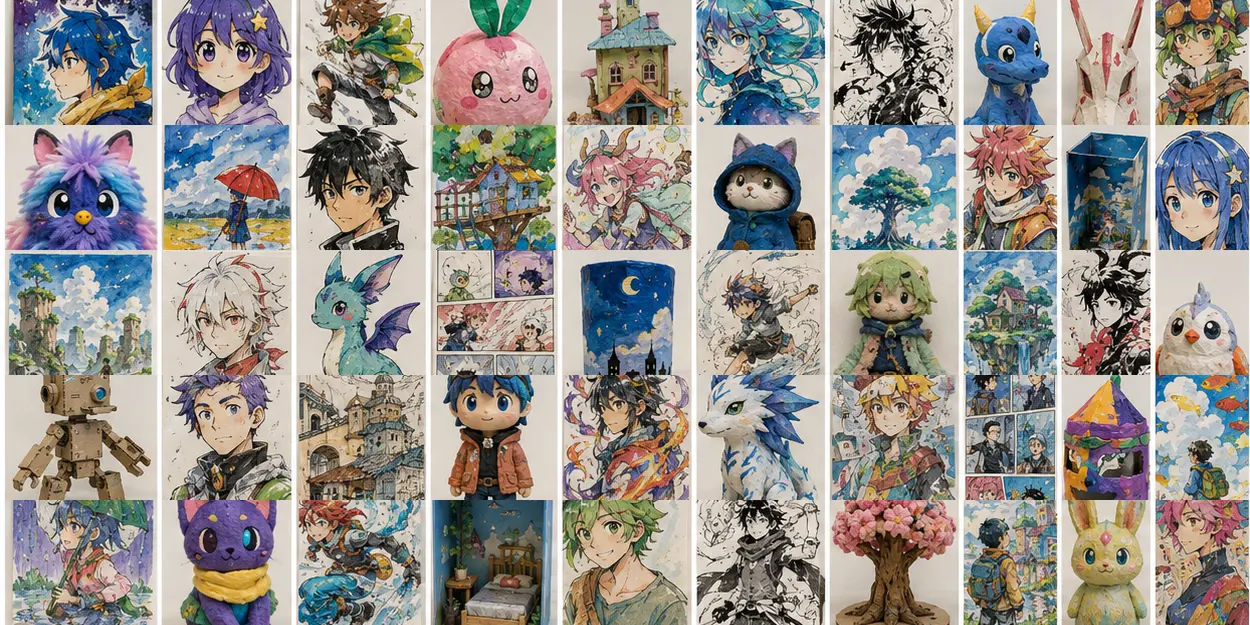
 SUCCESS EXAMPLE · NOT A TEMPLATE2709
Grade 5 · LESSON 469 OF 619
Treehouse Story World — Grade 5
Make a colorful environment painting featuring platforms, bridges, trees, and tiny story clues for a chosen audience, with ethical inspiration notes, iterations, and an artist statement. Use the example for ideas, but choose your own subject, colors, arrangement, and details.
Students define intent and audience, document iterations, and write a concise artist statement. Use the readiness check below to choose the starting point. Grade is a guide, not a limit on an individual learner. The example image is inspiration, not a required level of finish.
Right-sized challenge · Grade 5
Core goal: Choose an intention, test alternatives, and revise for an audience—not just add decoration. Project skill: Select and refine a color or mark strategy for an intended mood.
Before starting: Can the student connect a technique trial to an intended mood, story, or visual effect?
If it feels too hard: Teach the missing foundation first; use one subject and one technique while retaining student choice.
If the skill is already secure: Create a contrasting study of the same idea and explain how technique changes its meaning.
Adult support: Students select and justify a plan, document a revision, and give a short spoken or written artist statement.
Time: Plan in 45-minute meetings. Continue next meeting for drying, building, or unfamiliar techniques; do not rush completion.
Safety: Use school-approved, age-labeled materials. Adults manage sharp cutting, heated tools, aerosols, and specialty equipment. Avoid loose small parts for children who mouth objects; check allergies. Preview all outside images and links; children do not browse or create public accounts independently.
Suggested teaching starting points, not fixed ability bands. Adjust after observing the learner. Informed by NAEYC process-art guidance and the National Core Arts Standards framework.THE STUDIO GUIDE'S PROJECT PLAN
What students are making
Make a colorful environment painting featuring platforms, bridges, trees, and tiny story clues for a chosen audience, with ethical inspiration notes, iterations, and an artist statement. Use the example for ideas, but choose your own subject, colors, arrangement, and details.
Student directions
- 1
Make your own version of “Treehouse Story World”. Keep the subject in the title, but invent the design and story details.
- 2
Your core skill today: Select and refine a color or mark strategy for an intended mood.
- 3
Choose who could travel here and what they need to find. Sketch a large foreground shape, a middle path, and a distant shape.
- 4
Place the horizon and the largest building or land shape first. Make distant shapes smaller and less detailed.
- 5
Add one focal point and two clues to the imagined story. Paint or color large areas before windows, plants, and texture.
- 6
Check whether a viewer can locate the path and focal point. Adjust one overlap or contrast, then finish details.
- 7
Name one change that made the result clearer. Label or dictate your name and title, share the work, and clean the tools.
Artist connection
Anime & Manga · Backgrounds & Story Worlds
Hayao Miyazaki OPEN THE DIRECT EDUCATIONAL RESOURCE · TEACHER PREVIEW REQUIREDThe Academy Museum presents Miyazaki’s imageboards, character designs, storyboards, and backgrounds. Classroom connection: examine a teacher-selected setting and ask how the environment suggests a story. Give your own setting one clear place to explore. This is an artist study, not a painting tutorial.
Teaching rule: borrow the artist’s question, process, material thinking, or relationship to audience—not a recognizable style.
Current art-world practice
This project explores backgrounds & story worlds. Anime is animation; manga is comics. A still drawing, print, or model can explore their design ideas without itself being an animated film. Make an original character or world.
Ask students where they might encounter this practice today: a museum, public space, screen, community event, landscape, or temporary installation.
Teacher preparation
- Use school-approved, age-labeled materials. Adults manage sharp cutting, heated tools, aerosols, and specialty equipment. Avoid loose small parts for children who mouth objects; check allergies. Preview all outside images and links; children do not browse or create public accounts independently.
- Prepare washable paint and brushes or alternate painting tools in table groups; keep specialty materials at a distribution station.
- Preview the artist connection, choose one age-appropriate artwork for discussion, and avoid assigning students to copy a recognizable style.
- Print the matching worksheet and prepare a drying, display, testing, or photography area.
- Make one technique sample and one deliberately unsuccessful sample; do not make a finished project for copying.
Demonstration notes
- Show how to use and return the primary tools for painting.
- Model the key action slowly, narrating hand position, pressure, attachment, sequencing, or layering.
- Show how to test a small area before committing to the final surface.
- Demonstrate one repair: cover, crop, reinforce, reconnect, remix, or intentionally incorporate an accident.
Learning goals
- Explore how painting can communicate an idea.
- Make three connected artistic choices.
- Defend choices using intent, audience, and evidence.
Materials
- washable paint
- brushes or alternate painting tools
- heavy paper
- mixing trays
- table protection
- cleanup supplies
- optional student-proposed safe materials
Teaching sequence
- 1
0–5 MIN · CHECK READINESS — Can the student connect a technique trial to an intended mood, story, or visual effect?
- 2
5–10 MIN · MODEL — Select and refine a color or mark strategy for an intended mood. Use this lesson's demonstration notes.
- 3
10–15 MIN · TEST — Practice the main action on a small sample. Use the support option if it is not yet comfortable.
- 4
15–35 MIN · MAKE — Follow this lesson's student directions. Check the core skill before adding complexity.
- 5
35–40 MIN · REVIEW — Choose an intention, test alternatives, and revise for an audience—not just add decoration.
- 6
40–45 MIN · CLEAN + RECORD — Save work safely. Note the next step if another meeting is needed.
What success looks like
- The finished work clearly shows a colorful environment painting featuring platforms, bridges, trees, and tiny story clues for a chosen audience, with ethical inspiration notes, iterations, and an artist statement
- Materials and tools are controlled safely
- Feedback or testing leads to a visible revision
- The work meets the project constraint while remaining original
- Grade-level evidence: Choose an intention, test alternatives, and revise for an audience—not just add decoration. Select and refine a color or mark strategy for an intended mood.
Teacher questions
- What should a viewer notice first?
- How does this material help communicate the idea?
- How is this connected to the artist’s question without copying the artist’s style?
- What evidence shows the revision improved the work?
Common problems + responses
- Students copy the success image — cover it after observation and require a changed subject, structure, material, or color decision.
- The artist connection becomes imitation — return to the artist’s big question, process, or use of audience instead of surface appearance.
- Materials fail — pause for a joining or mark test using scraps.
- Cleanup replaces reflection — assign table jobs before distributing materials.
Access + differentiation
- Teach the missing foundation first; use one subject and one technique while retaining student choice.
- Offer adapted grips, a stabilized surface, rest breaks, and spoken or dictated responses. Adjust access without taking over the creative decisions.
- Create a contrasting study of the same idea and explain how technique changes its meaning.
Material substitutions
- No specialty material: translate the project into paper, cardboard, tape, and drawing tools.
- No camera or tablet: use a viewfinder drawing or sequential storyboard.
- Short class: finish planning and one focused study; continue construction next meeting.
- Advanced studio: change scale, audience, site, or material while preserving the core idea.
Four-part assessment rubric
IDEA — The project communicates an original response.
CRAFT — Materials are controlled, connected, and cared for.
PROCESS — The student plans, tests, persists, and revises.
REFLECTION — The student explains a choice using evidence.
Vocabulary
Student reflection
What did you notice? Which choice feels most like yours? What would you change next?
National Core Arts Standards
VA:Cr1.1.5a — Combine ideas innovatively
VA:Cr2.1.5a — Experiment and develop skills
VA:Cr3.1.5a — Write an artist statement
STUDENT PROMPT