 CHARACTER REFERENCE · CREATE YOUR OWN3060
Grade 3 · LESSON 466 OF 519
Sleepy Fox: Give Your Character a Voice
Make a short dialogue comic featuring a fox with an alarm clock. The character wants to wake up for a picnic, but keeps pressing snooze. One possible ending: it moves the picnic blanket beside the clock. Invent a different kind ending if you prefer.
One way your story could work
The character wants to wake up for a picnic, but keeps pressing snooze. One possible ending: it moves the picnic blanket beside the clock. Invent a different kind ending if you prefer. One speaker states the problem briefly; the other offers a surprising suggestion. The final picture shows the result rather than explaining it twice.
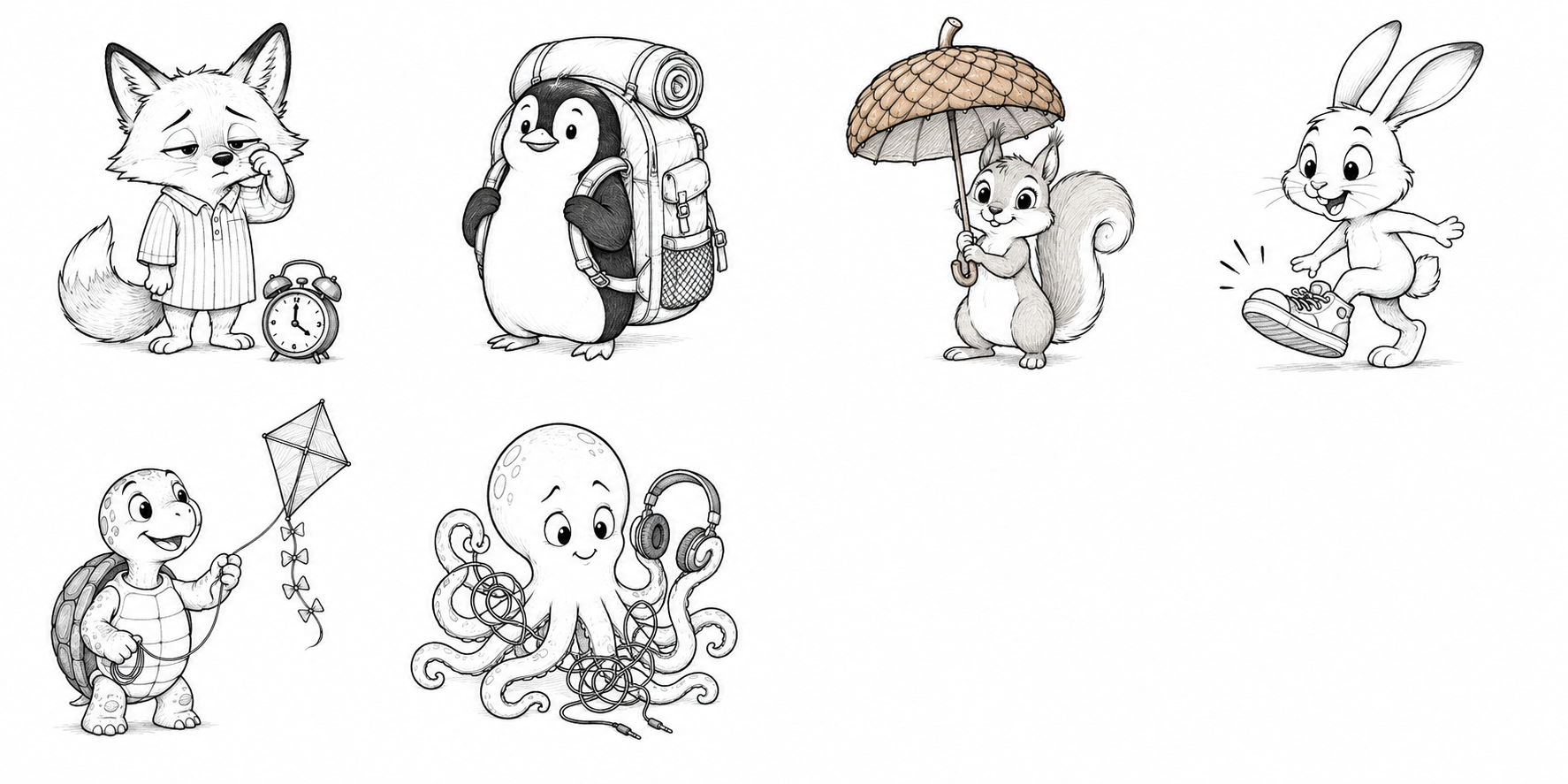
The image introduces the character and prop; it is shared across ten different skill lessons. Follow this lesson’s directions to make its specific finished piece, using your own design.
Explore Cartooning →
This is one of ten skill lessons using the Sleepy Fox story seed. Teach it independently or keep the character for a short skill sequence. Use large, clear shapes and show one understandable change. A character study is shared across this sequence; the written worked example explains this lesson’s specific outcome.
Right-sized challenge · Grade 3
Core goal: Use large, clear shapes and show one understandable change.
Before starting: Try one small dialogue & lettering sample. If the main action is unfamiliar, model it before the full project.
If it feels too hard: Reduce the number of details; offer prepared panel boxes, larger tools, a partner, and dictated labels.
If the skill is already secure: Make a second version with a different visual choice and compare how an unfamiliar reader understands it.
Adult support: Students choose their own designs. Adults prepare tools, supervise binding, and preview external resources.
Time: One 45-minute meeting for a focused study; two for a flipbook or a longer revision. Finish the core skill before optional decoration.
Safety: Use school drawing tools. Adults handle stapling and difficult cuts. Keep jokes kind; do not caricature classmates or stereotype identities. No public account or upload required.
Suggested teaching starting points, not fixed ability bands. Adjust after observing the learner. Informed by NAEYC process-art guidance and the National Core Arts Standards framework.THE STUDIO GUIDE'S PROJECT PLAN
What students are making
Make a short dialogue comic featuring a fox with an alarm clock. The character wants to wake up for a picnic, but keeps pressing snooze. One possible ending: it moves the picnic blanket beside the clock. Invent a different kind ending if you prefer.
Student directions
- 1
Your finished project is a short dialogue comic featuring a fox with an alarm clock. Read the story seed: The character wants to wake up for a picnic, but keeps pressing snooze. One possible ending: it moves the picnic blanket beside the clock. Invent a different kind ending if you prefer.
- 2
Start with round muzzle, pointed ears, and a big tail. These are helpful shapes, not a tracing template.
- 3
Write a short exchange between the character and a helpful friend. Choose words that add something the picture cannot show alone.
- 4
Plan speech-bubble space before drawing faces and props. Place the first speaker’s bubble first in reading order.
- 5
Draw the scene and point each bubble tail toward its speaker. Read aloud and trim repeated words.
- 6
Ask a partner to read the bubbles in order and identify the speakers. Move one bubble or shorten a line if needed. Use large, clear shapes and show one understandable change.
Artist connection
Charles M. Schulz OPEN THE DIRECT EDUCATIONAL RESOURCE · TEACHER PREVIEW REQUIREDThe Schulz Museum explains storytelling in four cartoon panels. Classroom connection: study the order of a teacher-selected strip, then tell an original everyday story. The page describes paid workshops; purchasing one is not required. For this lesson, investigate dialogue & lettering using your own a fox with an alarm clock.
Teaching rule: borrow the artist’s question, process, material thinking, or relationship to audience—not a recognizable style.
Current art-world practice
Original cartoon storytelling through dialogue & lettering. This classroom task studies visual communication; it does not reproduce a published character or strip.
Ask students where they might encounter this practice today: a museum, public space, screen, community event, landscape, or temporary installation.
Teacher preparation
- Preview the linked Charles M. Schulz resource and choose one classroom-appropriate example. No purchase or whole-film viewing is required.
- Prepare a quick dialogue & lettering demonstration using a different original character.
- Prepare a page or card layout for a short dialogue comic featuring a fox with an alarm clock; print the matching worksheet.
- Offer large paper and short word banks; an adult may scribe dialogue.
Demonstration notes
- Begin with round muzzle, pointed ears, and a big tail.
- Write a short exchange between the character and a helpful friend. Choose words that add something the picture cannot show alone.
- Plan speech-bubble space before drawing faces and props. Place the first speaker’s bubble first in reading order.
- Draw the scene and point each bubble tail toward its speaker. Read aloud and trim repeated words.
- Show one unclear version and explain a small revision rather than presenting a perfect picture to copy.
Learning goals
- Practice dialogue & lettering through an original cartoon.
- The reading order and speakers are clear, and dialogue supports rather than repeats the drawing.
- Use large, clear shapes and show one understandable change.
Materials
- drawing paper and scrap paper
- pencil and eraser
- optional black drawing pen
- ruler for panel guides when useful
Teaching sequence
- 1
0–5 MIN · LAUNCH — Introduce a fox with an alarm clock. Read the goal and obstacle; let students propose an ending.
- 2
5–10 MIN · MODEL — Demonstrate Write a short exchange between the character and a helpful friend. Choose words that add something the picture cannot show alone. Use round muzzle, pointed ears, and a big tail. Explain that the character reference is not a finished assignment.
- 3
10–15 MIN · TRY — Plan speech-bubble space before drawing faces and props. Place the first speaker’s bubble first in reading order. Students compare small trials before committing.
- 4
15–32 MIN · MAKE — Draw the scene and point each bubble tail toward its speaker. Read aloud and trim repeated words. Use large, clear shapes and show one understandable change.
- 5
32–40 MIN · TEST + REVISE — Ask a partner to read the bubbles in order and identify the speakers. Move one bubble or shorten a line if needed. Record the partner's response before explaining the intended meaning.
- 6
40–45 MIN · SHARE + CLEAN — Collect the work and one revision note. Do not grade drawing speed or realism.
What success looks like
- The work addresses a fox with an alarm clock and the chosen skill.
- The reading order and speakers are clear, and dialogue supports rather than repeats the drawing.
- The student makes an original choice rather than copying the reference.
- Use large, clear shapes and show one understandable change.
Teacher questions
- How can we show that the character wants to wake up for a picnic?
- Which visible clue shows that it keeps pressing snooze?
- Ask a partner to read the bubbles in order and identify the speakers. Move one bubble or shorten a line if needed.
- What does the reader understand without your explanation?
Common problems + responses
- The picture is busy — remove a background detail that does not support the skill.
- The character changes accidentally — compare its three identifying features.
- The ending is unclear — strengthen the visible clue before adding more words.
Access + differentiation
- Provide the page divisions or large head outlines; let the student choose the expression and action.
- Use large, clear shapes and show one understandable change.
- Extend by trying a second version with a different viewpoint or pacing and explaining the effect—not by adding unrelated materials.
Material substitutions
- Use pencil only if drawing pens are unavailable.
- Use larger paper, adapted grips, a partner recorder, or spoken reflection.
- For motion, arrange numbered drawings and move through them by hand if flipping is difficult.
Four-part assessment rubric
SKILL — The reading order and speakers are clear, and dialogue supports rather than repeats the drawing.
STORY — A viewer can identify the intended action or idea.
PROCESS — Trials and a purposeful change are visible.
REFLECTION — The student cites a reader response or visible detail.
Vocabulary
Student reflection
What did you notice? Which choice feels most like yours? What would you change next?
National Core Arts Standards
VA:Cr1.1.3a — Elaborate imaginative ideas
VA:Cr2.1.3a — Create personally satisfying art
VA:Cr3.1.3a — Revise through reflection
STUDENT PROMPT