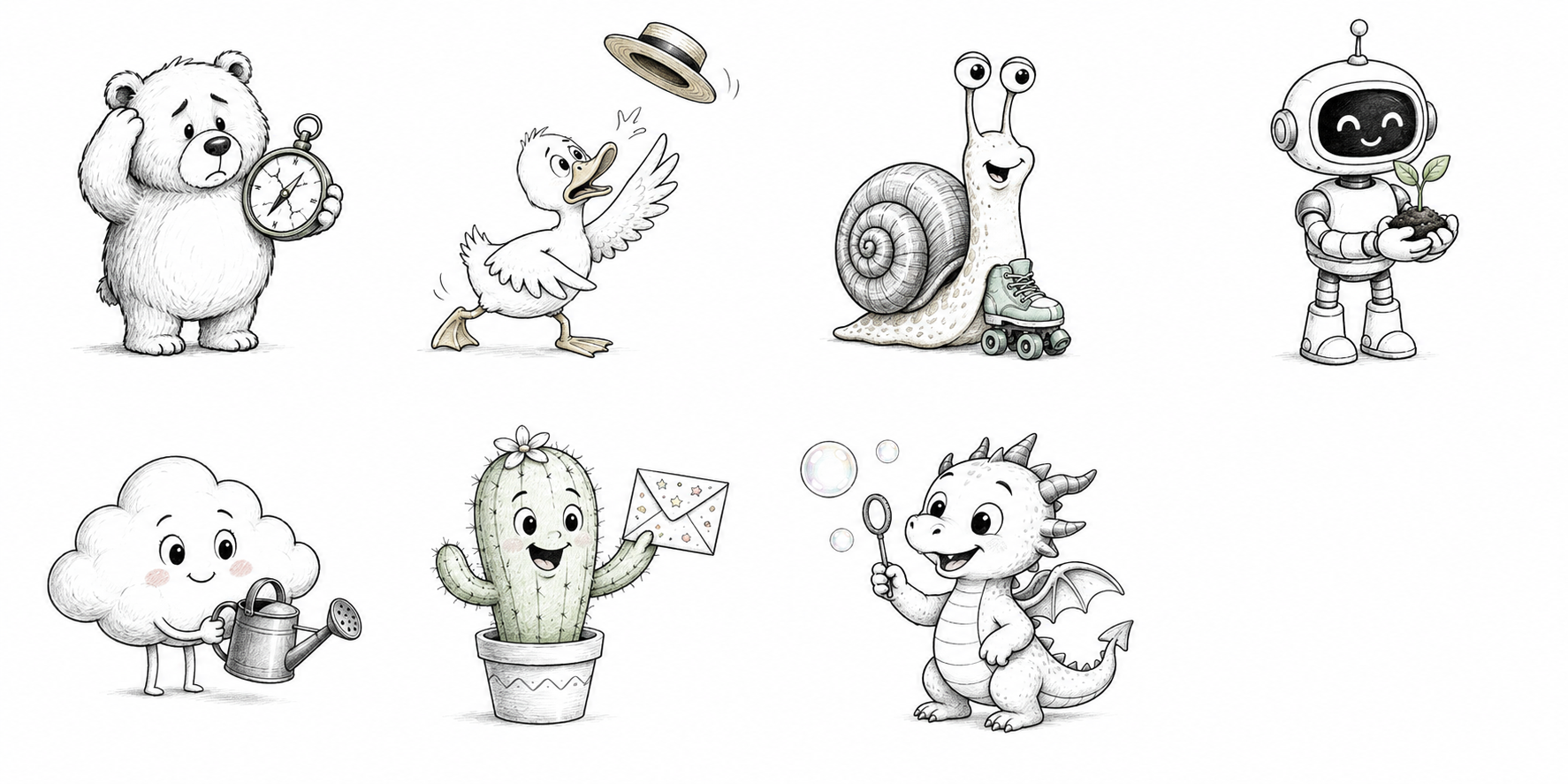
 CHARACTER REFERENCE · CREATE YOUR OWN3213
Grade 5 · LESSON 579 OF 619
Skating Snail: Keep Your Character the Same
Make a character consistency sheet featuring a snail with a roller skate. The character wants to move a little faster, but the skate rolls before the snail climbs on. One possible ending: it uses a small ramp and a helper to board safely. Invent a different kind ending if you prefer.
One way your story could work
The character wants to move a little faster, but the skate rolls before the snail climbs on. One possible ending: it uses a small ramp and a helper to board safely. Invent a different kind ending if you prefer. A front view, side view, and small action pose share the same head-to-body proportion and prop shape; not every line needs to be identical.
The image introduces the character and prop; it is shared across ten different skill lessons. Follow this lesson’s directions to make its specific finished piece, using your own design.
Explore Cartooning →
This is one of ten skill lessons using the Skating Snail story seed. Teach it independently or keep the character for a short skill sequence. Plan for an unfamiliar reader; compare alternatives and revise pacing, emphasis, or consistency using feedback. A character study is shared across this sequence; the written worked example explains this lesson’s specific outcome.
Right-sized challenge · Grade 5
Core goal: Plan for an unfamiliar reader; compare alternatives and revise pacing, emphasis, or consistency using feedback.
Before starting: Try one small model sheets sample. If the main action is unfamiliar, model it before the full project.
If it feels too hard: Reduce the number of details; offer prepared panel boxes, larger tools, a partner, and dictated labels.
If the skill is already secure: Make a second version with a different visual choice and compare how an unfamiliar reader understands it.
Adult support: Students choose their own designs. Adults prepare tools, supervise binding, and preview external resources.
Time: One 45-minute meeting for a focused study; two for a flipbook or a longer revision. Finish the core skill before optional decoration.
Safety: Use school drawing tools. Adults handle stapling and difficult cuts. Keep jokes kind; do not caricature classmates or stereotype identities. No public account or upload required.
Suggested teaching starting points, not fixed ability bands. Adjust after observing the learner. Informed by NAEYC process-art guidance and the National Core Arts Standards framework.THE STUDIO GUIDE'S PROJECT PLAN
What students are making
Make a character consistency sheet featuring a snail with a roller skate. The character wants to move a little faster, but the skate rolls before the snail climbs on. One possible ending: it uses a small ramp and a helper to board safely. Invent a different kind ending if you prefer.
Student directions
- 1
Your finished project is a character consistency sheet featuring a snail with a roller skate. Read the story seed: The character wants to move a little faster, but the skate rolls before the snail climbs on. One possible ending: it uses a small ramp and a helper to board safely. Invent a different kind ending if you prefer.
- 2
Start with spiral shell, long foot, and one wheeled skate. These are helpful shapes, not a tracing template.
- 3
Choose three features that must stay recognizable, such as ear shape, body proportion, and the prop.
- 4
Draw the character from the front and side using a shared height guide. Add a small action pose.
- 5
Compare feature sizes across views. Adjust differences that were accidental while keeping useful pose changes.
- 6
Ask a partner to identify the same three features across the drawings. Correct a disappearing or changing feature. Plan for an unfamiliar reader; compare alternatives and revise pacing, emphasis, or consistency using feedback.
Artist connection
Mo Willems OPEN THE DIRECT EDUCATIONAL RESOURCE · TEACHER PREVIEW REQUIREDThe Eric Carle Museum describes how simple shapes create expressive characters. Classroom connection: notice how a small face or pose change can communicate a feeling. For this lesson, investigate model sheets using your own a snail with a roller skate.
Teaching rule: borrow the artist’s question, process, material thinking, or relationship to audience—not a recognizable style.
Current art-world practice
Original cartoon storytelling through model sheets. This classroom task studies visual communication; it does not reproduce a published character or strip.
Ask students where they might encounter this practice today: a museum, public space, screen, community event, landscape, or temporary installation.
Teacher preparation
- Preview the linked Mo Willems resource and choose one classroom-appropriate example. No purchase or whole-film viewing is required.
- Prepare a quick model sheets demonstration using a different original character.
- Prepare a page or card layout for a character consistency sheet featuring a snail with a roller skate; print the matching worksheet.
- Offer large paper and short word banks; an adult may scribe dialogue.
Demonstration notes
- Begin with spiral shell, long foot, and one wheeled skate.
- Choose three features that must stay recognizable, such as ear shape, body proportion, and the prop.
- Draw the character from the front and side using a shared height guide. Add a small action pose.
- Compare feature sizes across views. Adjust differences that were accidental while keeping useful pose changes.
- Show one unclear version and explain a small revision rather than presenting a perfect picture to copy.
Learning goals
- Practice model sheets through an original cartoon.
- The character remains recognizable in two views and an action pose.
- Plan for an unfamiliar reader; compare alternatives and revise pacing, emphasis, or consistency using feedback.
Materials
- drawing paper and scrap paper
- pencil and eraser
- optional black drawing pen
- ruler for panel guides when useful
Teaching sequence
- 1
0–5 MIN · LAUNCH — Introduce a snail with a roller skate. Read the goal and obstacle; let students propose an ending.
- 2
5–10 MIN · MODEL — Demonstrate Choose three features that must stay recognizable, such as ear shape, body proportion, and the prop. Use spiral shell, long foot, and one wheeled skate. Explain that the character reference is not a finished assignment.
- 3
10–15 MIN · TRY — Draw the character from the front and side using a shared height guide. Add a small action pose. Students compare small trials before committing.
- 4
15–32 MIN · MAKE — Compare feature sizes across views. Adjust differences that were accidental while keeping useful pose changes. Plan for an unfamiliar reader; compare alternatives and revise pacing, emphasis, or consistency using feedback.
- 5
32–40 MIN · TEST + REVISE — Ask a partner to identify the same three features across the drawings. Correct a disappearing or changing feature. Record the partner's response before explaining the intended meaning.
- 6
40–45 MIN · SHARE + CLEAN — Collect the work and one revision note. Do not grade drawing speed or realism.
What success looks like
- The work addresses a snail with a roller skate and the chosen skill.
- The character remains recognizable in two views and an action pose.
- The student makes an original choice rather than copying the reference.
- Plan for an unfamiliar reader; compare alternatives and revise pacing, emphasis, or consistency using feedback.
Teacher questions
- How can we show that the character wants to move a little faster?
- Which visible clue shows that it the skate rolls before the snail climbs on?
- Ask a partner to identify the same three features across the drawings. Correct a disappearing or changing feature.
- What does the reader understand without your explanation?
Common problems + responses
- The picture is busy — remove a background detail that does not support the skill.
- The character changes accidentally — compare its three identifying features.
- The ending is unclear — strengthen the visible clue before adding more words.
Access + differentiation
- Reduce to one character and one main visual change; rehearse the skill in a small sample.
- Plan for an unfamiliar reader; compare alternatives and revise pacing, emphasis, or consistency using feedback.
- Extend by trying a second version with a different viewpoint or pacing and explaining the effect—not by adding unrelated materials.
Material substitutions
- Use pencil only if drawing pens are unavailable.
- Use larger paper, adapted grips, a partner recorder, or spoken reflection.
- For motion, arrange numbered drawings and move through them by hand if flipping is difficult.
Four-part assessment rubric
SKILL — The character remains recognizable in two views and an action pose.
STORY — A viewer can identify the intended action or idea.
PROCESS — Trials and a purposeful change are visible.
REFLECTION — The student cites a reader response or visible detail.
Vocabulary
Student reflection
What did you notice? Which choice feels most like yours? What would you change next?
National Core Arts Standards
VA:Cr1.1.5a — Combine ideas innovatively
VA:Cr2.1.5a — Experiment and develop skills
VA:Cr3.1.5a — Write an artist statement
STUDENT PROMPT